|
công cụ tìm kiếm bảng dữ liệu linh kiện điện tử |
|
|
công cụ tìm kiếm bảng dữ liệu linh kiện điện tử |
|
PIC16F1516 bảng dữ liệu(PDF) 200 Page - Microchip Technology |
|
|
|||||||||||||||||||||||||||||
PIC16F1516 bảng dữ liệu(HTML) 200 Page - Microchip Technology |
|
|
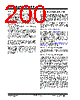
200 / 344 page  PIC16(L)F1516/7/8/9 DS41452B-page 200 Preliminary 2011 Microchip Technology Inc. 21.4.9 ACKNOWLEDGE SEQUENCE The 9th SCL pulse for any transferred byte in I2C is dedicated as an Acknowledge. It allows receiving devices to respond back to the transmitter by pulling the SDA line low. The transmitter must release control of the line during this time to shift in the response. The Acknowledge (ACK) is an active-low signal, pulling the SDA line low indicated to the transmitter that the device has received the transmitted data and is ready to receive more. The result of an ACK is placed in the ACKSTAT bit of the SSPCON2 register. Slave software, when the AHEN and DHEN bits are set, allow the user to set the ACK value sent back to the transmitter. The ACKDT bit of the SSPCON2 regis- ter is set/cleared to determine the response. Slave hardware will generate an ACK response if the AHEN and DHEN bits of the SSPCON3 register are clear. There are certain conditions where an ACK will not be sent by the slave. If the BF bit of the SSPSTAT register or the SSPOV bit of the SSPCON1 register are set when a byte is received. When the module is addressed, after the 8th falling edge of SCL on the bus, the ACKTIM bit of the SSPCON3 register is set. The ACKTIM bit indicates the Acknowledge time of the active bus. The ACKTIM Status bit is only active when the AHEN bit or DHEN bit is enabled. 21.5 I2C SLAVE MODE OPERATION The MSSP Slave mode operates in one of four modes selected in the SSPM bits of SSPCON1 register. The modes can be divided into 7-bit and 10-bit Addressing mode. 10-bit Addressing modes operate the same as 7-bit with some additional overhead for handling the larger addresses. Modes with Start and Stop bit interrupts operated the same as the other modes with SSPIF additionally get- ting set upon detection of a Start, Restart, or Stop condition. 21.5.1 SLAVE MODE ADDRESSES The SSPADD register (Register 21-6) contains the Slave mode address. The first byte received after a Start or Restart condition is compared against the value stored in this register. If the byte matches, the value is loaded into the SSPBUF register and an inter- rupt is generated. If the value does not match, the module goes Idle and no indication is given to the soft- ware that anything happened. The SSP Mask register (Register 21-5) affects the address matching process. See Section 21.5.9 “SSP Mask Register” for more information. 21.5.1.1 I2C Slave 7-bit Addressing Mode In 7-bit Addressing mode, the LSb of the received data byte is ignored when determining if there is an address match. 21.5.1.2 I2C Slave 10-bit Addressing Mode In 10-bit Addressing mode, the first received byte is compared to the binary value of ‘1 1 1 1 0 A9 A8 0’. A9 and A8 are the two MSb of the 10-bit address and stored in bits 2 and 1 of the SSPADD register. After the acknowledge of the high byte the UA bit is set and SCL is held low until the user updates SSPADD with the low address. The low address byte is clocked in and all 8 bits are compared to the low address value in SSPADD. Even if there is not an address match; SSPIF and UA are set, and SCL is held low until SSPADD is updated to receive a high byte again. When SSPADD is updated the UA bit is cleared. This ensures the module is ready to receive the high address byte on the next communication. A high and low address match as a write request is required at the start of all 10-bit addressing communi- cation. A transmission can be initiated by issuing a Restart once the slave is addressed, and clocking in the high address with the R/W bit set. The slave hard- ware will then acknowledge the read request and pre- pare to clock out data. This is only valid for a slave after it has received a complete high and low address byte match. |
|
Link URL |
| Cho đến nay ALLDATASHEET có giúp ích cho doanh nghiệp của bạn hay không? [ DONATE ] |
Alldatasheet là | Quảng cáo | Liên lạc với chúng tôi | Chính sách bảo mật | Liên kết đến bảng dữ liệu | Trao đổi link | Tìm kiếm theo nhà sản xuất All Rights Reserved©Alldatasheet.com |
| Russian : Alldatasheetru.com | Korean : Alldatasheet.co.kr | Spanish : Alldatasheet.es | French : Alldatasheet.fr | Italian : Alldatasheetit.com Portuguese : Alldatasheetpt.com | Polish : Alldatasheet.pl | Vietnamese : Alldatasheet.vn Indian : Alldatasheet.in | Mexican : Alldatasheet.com.mx | British : Alldatasheet.co.uk | New Zealand : Alldatasheet.co.nz |
|
Family Site : ic2ic.com |
icmetro.com |
 Vietnamese ▼
 English
 Chinese
 German
 Japanese
 Russian
 Korean
 Spanish
 French
 Italian
 Portuguese
 Polish
 Vietnamese
 Indian
 Mexican
 British
 New Zealand