|
công cụ tìm kiếm bảng dữ liệu linh kiện điện tử |
|
|
công cụ tìm kiếm bảng dữ liệu linh kiện điện tử |
|
PIC16F1516 bảng dữ liệu(PDF) 257 Page - Microchip Technology |
|
|
|||||||||||||||||||||||||||||
PIC16F1516 bảng dữ liệu(HTML) 257 Page - Microchip Technology |
|
|
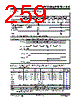
257 / 344 page  2011 Microchip Technology Inc. Preliminary DS41452B-page 257 PIC16(L)F1516/7/8/9 22.4.4 BREAK CHARACTER SEQUENCE The EUSART module has the capability of sending the special Break character sequences that are required by the LIN bus standard. A Break character consists of a Start bit, followed by 12 ‘0’ bits and a Stop bit. To send a Break character, set the SENDB and TXEN bits of the TXSTA register. The Break character trans- mission is then initiated by a write to the TXREG. The value of data written to TXREG will be ignored and all ‘0’s will be transmitted. The SENDB bit is automatically reset by hardware after the corresponding Stop bit is sent. This allows the user to preload the transmit FIFO with the next transmit byte following the Break character (typically, the Sync character in the LIN specification). The TRMT bit of the TXSTA register indicates when the transmit operation is active or Idle, just as it does during normal transmission. See Figure 22-9 for the timing of the Break character sequence. 22.4.4.1 Break and Sync Transmit Sequence The following sequence will start a message frame header made up of a Break, followed by an auto-baud Sync byte. This sequence is typical of a LIN bus master. 1. Configure the EUSART for the desired mode. 2. Set the TXEN and SENDB bits to enable the Break sequence. 3. Load the TXREG with a dummy character to initiate transmission (the value is ignored). 4. Write ‘55h’ to TXREG to load the Sync character into the transmit FIFO buffer. 5. After the Break has been sent, the SENDB bit is reset by hardware and the Sync character is then transmitted. When the TXREG becomes empty, as indicated by the TXIF, the next data byte can be written to TXREG. 22.4.5 RECEIVING A BREAK CHARACTER The Enhanced EUSART module can receive a Break character in two ways. The first method to detect a Break character uses the FERR bit of the RCSTA register and the Received data as indicated by RCREG. The Baud Rate Generator is assumed to have been initialized to the expected baud rate. A Break character has been received when; • RCIF bit is set • FERR bit is set • RCREG = 00h The second method uses the Auto-Wake-up feature described in Section 22.4.3 “Auto-Wake-up on Break” . By enabling this feature, the EUSART will sample the next two transitions on RX/DT, cause an RCIF interrupt, and receive the next data byte followed by another interrupt. Note that following a Break character, the user will typically want to enable the Auto-Baud Detect feature. For both methods, the user can set the ABDEN bit of the BAUDCON register before placing the EUSART in Sleep mode. FIGURE 22-9: SEND BREAK CHARACTER SEQUENCE Write to TXREG Dummy Write BRG Output (Shift Clock) Start bit bit 0 bit 1 bit 11 Stop bit Break TXIF bit (Transmit Interrupt Flag) TX (pin) TRMT bit (Transmit Shift Empty Flag) SENDB (send Break control bit) SENDB Sampled Here Auto Cleared |
|
Link URL |
| Cho đến nay ALLDATASHEET có giúp ích cho doanh nghiệp của bạn hay không? [ DONATE ] |
Alldatasheet là | Quảng cáo | Liên lạc với chúng tôi | Chính sách bảo mật | Liên kết đến bảng dữ liệu | Trao đổi link | Tìm kiếm theo nhà sản xuất All Rights Reserved©Alldatasheet.com |
| Russian : Alldatasheetru.com | Korean : Alldatasheet.co.kr | Spanish : Alldatasheet.es | French : Alldatasheet.fr | Italian : Alldatasheetit.com Portuguese : Alldatasheetpt.com | Polish : Alldatasheet.pl | Vietnamese : Alldatasheet.vn Indian : Alldatasheet.in | Mexican : Alldatasheet.com.mx | British : Alldatasheet.co.uk | New Zealand : Alldatasheet.co.nz |
|
Family Site : ic2ic.com |
icmetro.com |
 Vietnamese ▼
 English
 Chinese
 German
 Japanese
 Russian
 Korean
 Spanish
 French
 Italian
 Portuguese
 Polish
 Vietnamese
 Indian
 Mexican
 British
 New Zealand