|
công cụ tìm kiếm bảng dữ liệu linh kiện điện tử |
|
|
công cụ tìm kiếm bảng dữ liệu linh kiện điện tử |
|
WM9705 bảng dữ liệu(PDF) 22 Page - Wolfson Microelectronics plc |
|
|
|||||||||||||||||||||||||||||
WM9705 bảng dữ liệu(HTML) 22 Page - Wolfson Microelectronics plc |
|
|
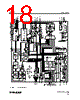
22 / 55 page  WM9705 Production Data w PD Rev 4.4 August 2006 22 When a headphone is connected the low impedance to ground of the headset pulls down the DC level to near ground. If a headset with microphone is plugged in, the high impedance of the microphone does not pull down the DC level on the tip connection, the DC on this pin now rising to near positive supply. This change in DC level is detected, so allowing detection of change from headphone to microphone, (or nothing plugged in of course). When this event is detected, the headphone amplifier that drives the tip connection is turned off, and the signal on this pin is routed instead to the MIC1 input as a microphone input. This auto-detect comparator is enabled by setting bit HSCMP. The pull-up current is enabled by setting bit MPUEN in register 5Ch and also toggles the interrupt signal on the PENDET pin. When bit HSDT is set the mic1 input is connected to a comparator with a threshold set at mid- rail. When the comparator output is low, then the headphone driver is enabled. When the comparator output goes high (that is the pull-up current multiplied by the external impedance to ground on the mic1 pin is greater than mid-rail), the headphone amplifier is turned off and the mic1 signal is taken internally from the headphone output pin (39). RIGHT MIXER HPOUTL HPOUTR L R LEFT MIXER HPGND HEAD PHONE MIC UP: MONO HEADSET WITH MIC DOWN: STEREO HEADPHONE HSEN reg 5Ch MIC1 MIC2 OFF (hi-Z) '1' '0' HSDT reg 5Ch INTERNAL MIC MIC AMP '1' '0' MPUEN reg 5Ch 5mA VMID HSCP reg 5Ch PEN LOGIC PENDET HPVOL reg 04h MS reg 20h + - HSCMP reg 5Ch Figure 10 Headset Autodetect Figure 10 shows this function schematically. The output signal from the comparator is accessible by reading bit HSCP in register 5Ch. Auto detect may be used by setting HSEN bit, or external control by using the HSDT bit which is an over-ride that forces the headset tri-state and microphone path switching function to occur. This function would allow, for example, a stereo headphone to be used that had a microphone in the connecting lead, and a switch. The switch changes the headphone into a mono headset with microphone connected via the tip connection on the jack. If used in a product such as an MP3 capable phone it would allow the user to switch from headphone use to headset use by simply switching a single switch in the headphone cable, so at the same time answering or initiating telephone calls. It may also be possible to use the pull-up current to provide so called ‘phantom power’ to dynamic microphones with appropriate choice of microphone. |
|
Link URL |
| Cho đến nay ALLDATASHEET có giúp ích cho doanh nghiệp của bạn hay không? [ DONATE ] |
Alldatasheet là | Quảng cáo | Liên lạc với chúng tôi | Chính sách bảo mật | Liên kết đến bảng dữ liệu | Trao đổi link | Tìm kiếm theo nhà sản xuất All Rights Reserved©Alldatasheet.com |
| Russian : Alldatasheetru.com | Korean : Alldatasheet.co.kr | Spanish : Alldatasheet.es | French : Alldatasheet.fr | Italian : Alldatasheetit.com Portuguese : Alldatasheetpt.com | Polish : Alldatasheet.pl | Vietnamese : Alldatasheet.vn Indian : Alldatasheet.in | Mexican : Alldatasheet.com.mx | British : Alldatasheet.co.uk | New Zealand : Alldatasheet.co.nz |
|
Family Site : ic2ic.com |
icmetro.com |
 Vietnamese ▼
 English
 Chinese
 German
 Japanese
 Russian
 Korean
 Spanish
 French
 Italian
 Portuguese
 Polish
 Vietnamese
 Indian
 Mexican
 British
 New Zealand