|
công cụ tìm kiếm bảng dữ liệu linh kiện điện tử |
|
|
công cụ tìm kiếm bảng dữ liệu linh kiện điện tử |
|
MAX6666 bảng dữ liệu(PDF) 5 Page - Maxim Integrated Products |
|
|
|||||||||||||||||||||||||||||
MAX6666 bảng dữ liệu(HTML) 5 Page - Maxim Integrated Products |
|
|
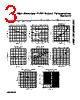
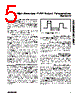
5 / 7 page  Detailed Description The MAX6666/MAX6667 are high-accuracy, low-cost, low current (200µA typ) temperature sensors ideal for interfacing with µCs or µPs. The MAX6666/MAX6667 convert the ambient temperature into a ratiometric PWM output at a nominal frequency of 35Hz (±20%) at +25°C. The time periods, t1 (high) and t2 (low) (Figure 1), are easily read by the µP’s timer/counter port. To calculate the temperature, use the expression below: Temperature (°C) = +235 - (400 x t1) / t2 The µC or µP measures the output of the MAX6666/ MAX6667 by counting t1 and t2 and computing the temperature based on their ratio. The resolution of the count is a function of the processor clock frequency and the resolution of the counter. The MAX6666/ MAX6667 have a resolution of approximately 11 bits. Always use the same clock for t1 and t2 counters so that the temperature is strictly based on a ratio of the two times, thus eliminating errors due to different clocks’ frequencies. The MAX6666 (Figure 2a) has a push-pull output and provides rail-to-rail output drive. The ability to source and sink current allows the MAX6666 to drive capaci- tive loads up to 10nF with less than 1°C error. The MAX6667 (Figure 2b) has an open-drain output. The output capacitance should be minimized in MAX6667 applications because the sourcing current is set by the pullup resistor. If the output capacitance becomes too large, lengthy rise and fall times distort the pulse width, resulting in inaccurate measurements. Applications Information Accurate temperature monitoring requires a good ther- mal contact between the MAX6666/MAX6667 and the object being monitored. A precise temperature mea- surement depends on the thermal resistance between the object being monitored and the MAX6666 die. Heat flows in and out of plastic packages primarily through the leads. For the best thermal contact, connect all unused pins to ground. If the sensor is intended to measure the temperature of a heat-generating compo- nent on the circuit board, mount the device as close as possible to that component and share the ground traces (if they are not too noisy) with the component. This maximizes the heat transfer from the component to the sensor. Power-Supply Bypassing The MAX6666/MAX6667 operate from a +3V to +5.5V supply. If a noisy power-supply line is used, bypass VCC to GND with a 0.1µF capacitor. Power Supply from µP Port Pin The low quiescent current of the MAX6666/MAX6667 enables it to be powered from a logic line, which meets the requirements for supply voltage range. This pro- vides a simple shutdown function to totally eliminate quiescent current by taking the logic line low. The logic line must be able to withstand the 0.1µF power-supply bypass capacitance. Galvanic Isolation Use an optocoupler to isolate the MAX6666/MAX6667 whenever a high common-mode voltage is present. Because some optocouplers have turn-off times that are much longer than their turn-on times, choose an optocoupler with equal turn-on and turn-off times. Unequal turn-on/turn-off times produce an error in the temperature reading. Thermal Considerations Self-heating may cause the temperature measurement accuracy of the MAX6666/MAX6667 to degrade in some applications. The quiescent dissipation and the power dissipated by the digital output may cause errors in obtaining the accurate temperature measure- ment. The temperature errors depend on the thermal conductivity of the package (SOT23, 140°C/W), the mounting technique, and the airflow. Static dissipation in the MAX6666/MAX6667 is typically 4.5mW operating at 5V with no load. As a worst-case example, consider the MAX6667 and its maximum rated load of 5mA and assume a maximum output voltage of 0.8V adds 4mW power dissipation. Use Figure 3 to estimate the temper- ature error. High-Accuracy PWM Output Temperature Sensors _______________________________________________________________________________________ 5 t2 t1 Figure 1. MAX6666/MAX6667 PWM Output |
|
|
Link URL |
| Cho đến nay ALLDATASHEET có giúp ích cho doanh nghiệp của bạn hay không? [ DONATE ] |
Alldatasheet là | Quảng cáo | Liên lạc với chúng tôi | Chính sách bảo mật | Liên kết đến bảng dữ liệu | Trao đổi link | Tìm kiếm theo nhà sản xuất All Rights Reserved©Alldatasheet.com |
| Russian : Alldatasheetru.com | Korean : Alldatasheet.co.kr | Spanish : Alldatasheet.es | French : Alldatasheet.fr | Italian : Alldatasheetit.com Portuguese : Alldatasheetpt.com | Polish : Alldatasheet.pl | Vietnamese : Alldatasheet.vn Indian : Alldatasheet.in | Mexican : Alldatasheet.com.mx | British : Alldatasheet.co.uk | New Zealand : Alldatasheet.co.nz |
|
Family Site : ic2ic.com |
icmetro.com |
 Vietnamese ▼
 English
 Chinese
 German
 Japanese
 Russian
 Korean
 Spanish
 French
 Italian
 Portuguese
 Polish
 Vietnamese
 Indian
 Mexican
 British
 New Zealand