 |
công cụ tìm kiếm bảng dữ liệu linh kiện điện tử |
|
|
công cụ tìm kiếm bảng dữ liệu linh kiện điện tử |
|
The question interval is too short.
Please try again in a few seconds.

Hello, Please ask a question about MAX6666_09 Datasheet
# Example questions:
➢ What is the primary difference between the max6666 and max6667 in terms of their output configuration, and how does this impact application considerations?
➢ Describe how self-heating can affect the accuracy of the temperature measurement and what steps can be taken to minimize this error.
➢ Explain this formula and describe how a microcontroller would use the 't1' and 't2' values to determine the temperature.
| Part No. | MAX6666_09 |
| Manufacturer | MAXIM |
| Size | 124 Kbytes |
| Pages | 7 pages |
| Description | High-Accuracy PWM Output Temperature Sensors |





1. General Overview & Function
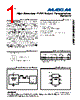
️· What are they? High-accuracy, low-cost, low-current temperature sensors.
️· How they work: Convert temperature into a ratiometric PWM (Pulse Width Modulation) output signal. This means the frequency is stable, and the duty cycle (pulse width) changes with temperature.
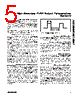
️· Why PWM? The PWM signal's time periods (t1 - high, t2 - low) can be easily read by a microcontroller's timer/counter. The temperature is calculated based on the ratio of these times.
️· Resolution: ~11 bits resolution.
️· Nominal Frequency: 35Hz (±20%) at +25°C.
️· Formula: Temperature (°C) = +235 - (400 x t 1 ) / t 2
2. Key Differences: MAX6666 vs. MAX6667
️· MAX6666:
- Push-Pull Output: Provides rail-to-rail output drive, allowing it to drive capacitive loads up to 10nF with minimal error. Can source and sink current.
️· MAX6667:
- Open-Drain Output: Requires a pull-up resistor. Less suitable for driving capacitive loads - minimize capacitance for best results.
3. Applications & Considerations
️· Thermal Contact: Critical for accuracy. Ensure good thermal contact between the sensor and the object being measured. Connect unused pins to ground. Share ground traces for heat-generating components.
️· Power Supply:
- Bypass VCC to GND with a 0.1µF capacitor.
- Can be powered from a microcontroller's logic line.
️· Galvanic Isolation: Use an optocoupler when a high common-mode voltage is present.
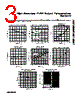
️· Temperature Error: Errors can arise from self-heating and load current. Consult Figure 3 for MAX6666.
️· Low-Voltage Logic: Use the MAX6667's open-drain output to drive low-voltage devices using a pull-up resistor (current limited to ~1mA).
4. Package and Pin Descriptions
️· Package: 6-pin SOT23
️· Pinout:
- DOUT: Digital Output Pin (PWM signal).
- VCC: Supply Voltage (3V to 5.5V)
- GND: Ground
- I.C.: Internally Connected (Leave unconnected or connect to GND).
5. Key Performance Indicators
️· Operating Voltage: 3V to 5.5V
️· Quiescent Current: Typically 200µA (low-current)
6. Revision History
*A few details were updated in the 8/09 revision, including the ordering information, pin configuration, absolute maximum ratings, and pin descriptions.*
In essence, the MAX6666/MAX6667 offer a simple and accurate way to monitor temperature using a microcontroller, with design considerations tailored to the specific output configuration (push-pull or open-drain).
1. General Overview & Function
️· What are they? High-accuracy, low-cost, low-current temperature sensors.
️· How they work: Convert temperature into a ratiometric PWM (Pulse Width Modulation) output signal. This means the frequency is stable, and the duty cycle (pulse width) changes with temperature.
️· Why PWM? The PWM signal's time periods (t1 - high, t2 - low) can be easily read by a microcontroller's timer/counter. The temperature is calculated based on the ratio of these times.
️· Resolution: ~11 bits resolution.
️· Nominal Frequency: 35Hz (±20%) at +25°C.
️· Formula: Temperature (°C) = +235 - (400 x t 1 ) / t 2
2. Key Differences: MAX6666 vs. MAX6667
️· MAX6666:
- Push-Pull Output: Provides rail-to-rail output drive, allowing it to drive capacitive loads up to 10nF with minimal error. Can source and sink current.
️· MAX6667:
- Open-Drain Output: Requires a pull-up resistor. Less suitable for driving capacitive loads - minimize capacitance for best results.
3. Applications & Considerations
️· Thermal Contact: Critical for accuracy. Ensure good thermal contact between the sensor and the object being measured. Connect unused pins to ground. Share ground traces for heat-generating components.
️· Power Supply:
- Bypass VCC to GND with a 0.1µF capacitor.
- Can be powered from a microcontroller's logic line.
️· Galvanic Isolation: Use an optocoupler when a high common-mode voltage is present.
️· Temperature Error: Errors can arise from self-heating and load current. Consult Figure 3 for MAX6666.
️· Low-Voltage Logic: Use the MAX6667's open-drain output to drive low-voltage devices using a pull-up resistor (current limited to ~1mA).
4. Package and Pin Descriptions
️· Package: 6-pin SOT23
️· Pinout:
- DOUT: Digital Output Pin (PWM signal).
- VCC: Supply Voltage (3V to 5.5V)
- GND: Ground
- I.C.: Internally Connected (Leave unconnected or connect to GND).
5. Key Performance Indicators
️· Operating Voltage: 3V to 5.5V
️· Quiescent Current: Typically 200µA (low-current)
6. Revision History
*A few details were updated in the 8/09 revision, including the ordering information, pin configuration, absolute maximum ratings, and pin descriptions.*
In essence, the MAX6666/MAX6667 offer a simple and accurate way to monitor temperature using a microcontroller, with design considerations tailored to the specific output configuration (push-pull or open-drain).
| Part No. | MAX6666_09 |
| Manufacturer | MAXIM |
| Size | 124 Kbytes |
| Pages | 7 pages |
| Description | High-Accuracy PWM Output Temperature Sensors |
| Cho đến nay ALLDATASHEET có giúp ích cho doanh nghiệp của bạn hay không? [ DONATE ] |
Alldatasheet là | Quảng cáo | Liên lạc với chúng tôi | Chính sách bảo mật | Liên kết đến bảng dữ liệu | Trao đổi link | Tìm kiếm theo nhà sản xuất All Rights Reserved©Alldatasheet.com |
| Russian : Alldatasheetru.com | Korean : Alldatasheet.co.kr | Spanish : Alldatasheet.es | French : Alldatasheet.fr | Italian : Alldatasheetit.com Portuguese : Alldatasheetpt.com | Polish : Alldatasheet.pl | Vietnamese : Alldatasheet.vn Indian : Alldatasheet.in | Mexican : Alldatasheet.com.mx | British : Alldatasheet.co.uk | New Zealand : Alldatasheet.co.nz |
|
Family Site : ic2ic.com |
icmetro.com |
 Vietnamese ▼
  English
 Chinese
 German
 Japanese
 Russian
 Korean
 Spanish
 French
 Italian
 Portuguese
 Polish
 Indian
 Mexican
 British
 New Zealand