 |
công cụ tìm kiếm bảng dữ liệu linh kiện điện tử |
|
|
công cụ tìm kiếm bảng dữ liệu linh kiện điện tử |
|
The question interval is too short.
Please try again in a few seconds.

Hello, Please ask a question about LPV511MG Datasheet
# Example questions:
➢ What is the recommended method to improve phase margin when driving a capacitive load with the lpv511, and why is this important?
➢ What is the typical input bias current range of the lpv511, and how does it change across the common mode input voltage range?
➢ Explain how this is achieved within the lpv511, referencing the internal components involved.
| Part No. | LPV511MG |
| Manufacturer | NSC |
| Size | 836 Kbytes |
| Pages | 14 pages |
| Description | 880 nA, Rail-to-Rail Input and Output Operational Amplifier |


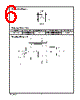


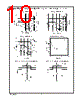
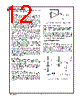


1. Overview & Key Features
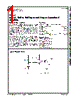
️· What it is: The LPV511 is a single, rail-to-rail operational amplifier.
️· Rail-to-Rail Inputs/Outputs: This is a *major* feature. It means the input and output voltage ranges can swing very close to the power supply rails (2.7V to 12V), allowing for maximum signal dynamic range.
️· Low Quiescent Current: This is crucial for battery-powered applications. The datasheet emphasizes the low current draw.
️· Applications: Designed for battery current sensing, summing amplifiers, and generally situations where low power and rail-to-rail operation are required.
2. Technical Specifications (Highlights)
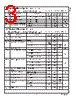
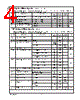
️· Supply Voltage: 2.7V to 12V (single supply)
️· Input Common Mode Range: Can swing close to the supply rails.
️· Output Voltage Swing: Swings close to the supply rails.
️· Input Bias Current: Very low (a key benefit for battery operation).
️· Gain Bandwidth Product: Not explicitly provided but implied to be reasonable for typical op-amp applications.
️· Other: The datasheet includes a lot of typical performance characteristics graphs, which are essential for in-depth understanding.
3. Important Design Considerations & Application Notes
️· Input Stage & Common Mode Voltage:
- The rail-to-rail input is achieved by using a combination of PNP and NPN differential pairs.
- The offset voltage (V<sub>OS</sub>) changes with the common mode input voltage (V<sub>CM</sub>). This is especially important when signal amplitudes are comparable to the offset voltage or high accuracy is required.
- Be aware of polarity changes in input bias current (I<sub>B</sub>) and parameters (like PSRR & CMRR) when the input voltage crosses a transition region.
️· Output Stage:
- The output voltage swing is limited by the power supply voltage.
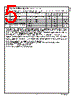
️· Driving Capacitive Loads: Directly connecting the output to large capacitive loads can reduce phase margin and stability. A small series resistor is recommended to mitigate this.
️· Power Supply Bypass: Bypass the power supply pins (V+ and V-) with ceramic capacitors (e.g., 0.1 µF) near the pins to reduce noise and improve performance.
️· Layout: Minimize trace lengths and external component leads to reduce stray capacitance and noise.
4. Applications Examples (Circuits)
️· Battery Current Sensing: The low quiescent current and rail-to-rail input make this ideal.
️· Summing Amplifier: Again, the rail-to-rail operation maximizes the dynamic range.
5. Regulatory and Compliance
️· Life Support Policy: Explicitly states restrictions on use in life-support devices without written approval.
️· Banned Substances Compliance: Complies with RoHS and doesn't contain banned substances.
In essence, the LPV511 is a versatile op-amp targeted at low-power, rail-to-rail applications. The datasheet highlights the importance of understanding common-mode voltage effects and potential stability issues when driving capacitive loads.
1. Overview & Key Features
️· What it is: The LPV511 is a single, rail-to-rail operational amplifier.
️· Rail-to-Rail Inputs/Outputs: This is a *major* feature. It means the input and output voltage ranges can swing very close to the power supply rails (2.7V to 12V), allowing for maximum signal dynamic range.
️· Low Quiescent Current: This is crucial for battery-powered applications. The datasheet emphasizes the low current draw.
️· Applications: Designed for battery current sensing, summing amplifiers, and generally situations where low power and rail-to-rail operation are required.
2. Technical Specifications (Highlights)
️· Supply Voltage: 2.7V to 12V (single supply)
️· Input Common Mode Range: Can swing close to the supply rails.
️· Output Voltage Swing: Swings close to the supply rails.
️· Input Bias Current: Very low (a key benefit for battery operation).
️· Gain Bandwidth Product: Not explicitly provided but implied to be reasonable for typical op-amp applications.
️· Other: The datasheet includes a lot of typical performance characteristics graphs, which are essential for in-depth understanding.
3. Important Design Considerations & Application Notes
️· Input Stage & Common Mode Voltage:
- The rail-to-rail input is achieved by using a combination of PNP and NPN differential pairs.
- The offset voltage (V<sub>OS</sub>) changes with the common mode input voltage (V<sub>CM</sub>). This is especially important when signal amplitudes are comparable to the offset voltage or high accuracy is required.
- Be aware of polarity changes in input bias current (I<sub>B</sub>) and parameters (like PSRR & CMRR) when the input voltage crosses a transition region.
️· Output Stage:
- The output voltage swing is limited by the power supply voltage.
️· Driving Capacitive Loads: Directly connecting the output to large capacitive loads can reduce phase margin and stability. A small series resistor is recommended to mitigate this.
️· Power Supply Bypass: Bypass the power supply pins (V+ and V-) with ceramic capacitors (e.g., 0.1 µF) near the pins to reduce noise and improve performance.
️· Layout: Minimize trace lengths and external component leads to reduce stray capacitance and noise.
4. Applications Examples (Circuits)
️· Battery Current Sensing: The low quiescent current and rail-to-rail input make this ideal.
️· Summing Amplifier: Again, the rail-to-rail operation maximizes the dynamic range.
5. Regulatory and Compliance
️· Life Support Policy: Explicitly states restrictions on use in life-support devices without written approval.
️· Banned Substances Compliance: Complies with RoHS and doesn't contain banned substances.
In essence, the LPV511 is a versatile op-amp targeted at low-power, rail-to-rail applications. The datasheet highlights the importance of understanding common-mode voltage effects and potential stability issues when driving capacitive loads.
| Part No. | LPV511MG |
| Manufacturer | NSC |
| Size | 836 Kbytes |
| Pages | 14 pages |
| Description | 880 nA, Rail-to-Rail Input and Output Operational Amplifier |
| Cho đến nay ALLDATASHEET có giúp ích cho doanh nghiệp của bạn hay không? [ DONATE ] |
Alldatasheet là | Quảng cáo | Liên lạc với chúng tôi | Chính sách bảo mật | Liên kết đến bảng dữ liệu | Trao đổi link | Tìm kiếm theo nhà sản xuất All Rights Reserved©Alldatasheet.com |
| Russian : Alldatasheetru.com | Korean : Alldatasheet.co.kr | Spanish : Alldatasheet.es | French : Alldatasheet.fr | Italian : Alldatasheetit.com Portuguese : Alldatasheetpt.com | Polish : Alldatasheet.pl | Vietnamese : Alldatasheet.vn Indian : Alldatasheet.in | Mexican : Alldatasheet.com.mx | British : Alldatasheet.co.uk | New Zealand : Alldatasheet.co.nz |
|
Family Site : ic2ic.com |
icmetro.com |
 Vietnamese ▼
  English
 Chinese
 German
 Japanese
 Russian
 Korean
 Spanish
 French
 Italian
 Portuguese
 Polish
 Indian
 Mexican
 British
 New Zealand